Born in 1969 in Albertville, Delphine Coindet lives and works in Chambery. She worked at the Cirva in 2014 and 2015.
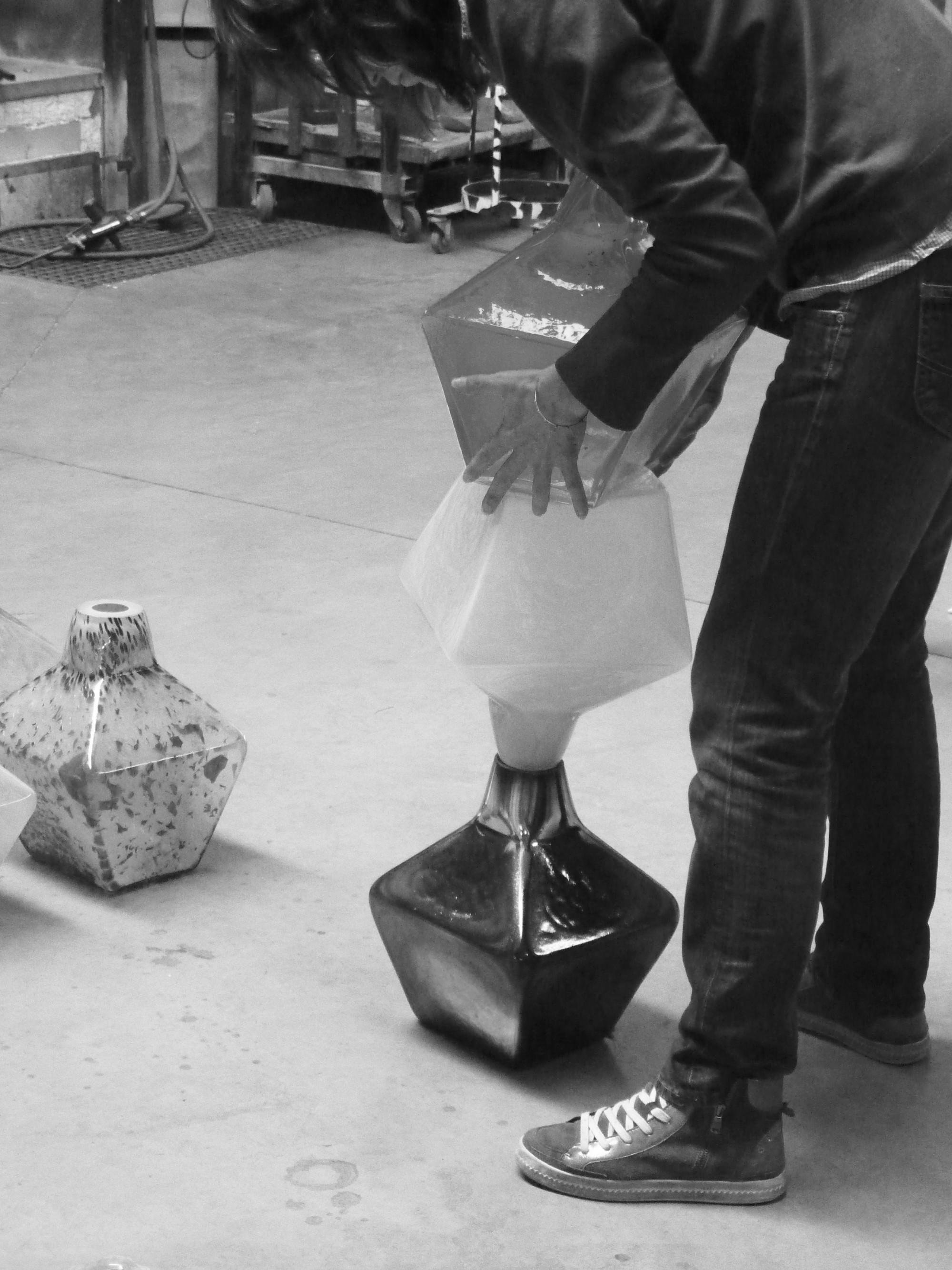
Delphine Coindet dans l’atelier du Cirva, 2015. Photo : Cirva
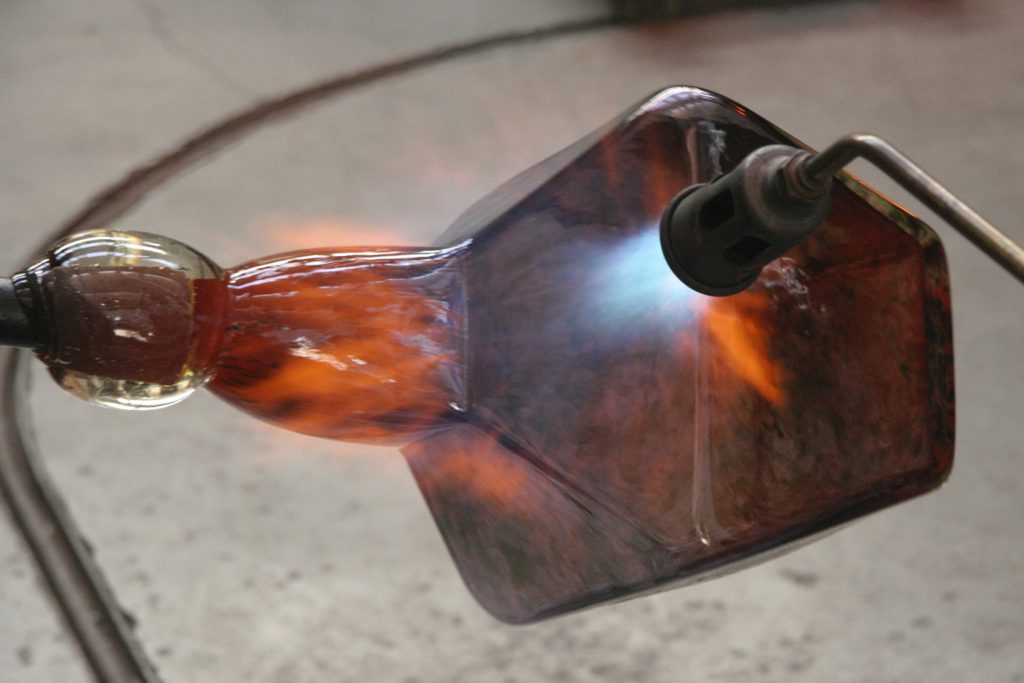
Séjour de travail de Delphine Coindet au Cirva, 2014. Vidéo : C. Capelle / Cirva
- Prismes, 2014–2015 (plusieurs sculptures dont une collection FRAC Pays de la Loire et une collection Mudac, Lausanne)
- Chapeaux melon, 2014–2015
2015
- « Delphine Coindet. Modes & usages de l’art », centre d’art contemporain le Crédac, Ivry-sur-Seine.
2015–2016
- « Ouverture pour inventaire », FRAC des Pays de la Loire, Carquefou.
2016
- « - 12 000 >> 2016 », musée Sainte-Croix, Poitiers.
- « Prismes - Delphine Coindet », médiathèque, Mouans-Sartoux.
2017
- « Une maison de verre – Le Cirva, Centre international de recherche sur le verre et les arts plastiques », musée Cantini, Marseille.
2017–2018
- « Un choix de sculptures », Collégiale Saint-Martin, Angers.
2018
- « Verre en scène #3 », Mudac, Lausanne (Suisse).
- « Biarritz 1918 & 2018 », espace muséal du Bellevue, Biarritz.
The large multicolored pyramid conceived by Delphine Coindet at Cirva is composed of forty-two modules that are nearly identical yet each distinct in their subtle imperfections. Here, Delphine Coindet draws on the conventions of minimalist sculpture while introducing garish, vibrant colors reminiscent of certain Murano glass pieces from the 1970s. In doing so, she dramatically juxtaposes genres and aesthetics. Often questioning the boundaries between art and design, between artwork and object, Delphine Coindet seeks to explore what lies behind the sculpture, as if behind the scenes of a theater. To this end, she adopts approaches that are often illusionistic, akin to a set that visitors can walk through and experience.
An interview organised by Cirva and led by Isabelle Reiher, February 2015
Isabelle Reiher [IR]
A certain theatricality is almost always present in your work, manifested through a penchant for set design, the exaggeration of forms, and a kind of hyper-realism that evokes a sense of fiction and artifice. Are these elements still significant in your work, and how might they evolve?
Delphine Coindet [DC]
The theater stage can be viewed as a cosmogony of the world seen through vertical strata, that is, multiple planes arranged one behind the other, from the protagonists to the wings. However, just as theater imposes a physical distance, the space of sculpture allows us to grasp these layers in all their facets. To literally see what is happening behind the scenes. These notions are expressed in my work through various exhibition strategies conceived as open stagings, collages, and juxtapositions of heterogeneous materials and techniques.
It would seem that the motifs or details of the setting are always clues to our surrounding reality and that they inform us about these very intrinsic components.
Thus, I attempt to demonstrate the artificiality of any attempt at representation by seeking to make the illusionist power it implies ever more tangible.
[IR]
During a conversation, you once told me that you were becoming increasingly interested in design issues and that you were incorporating a kind of art/design or art/object dialectic into your work. Could you elaborate on this point, which seems all the more significant in the work you’re doing at Cirva?
[DC]
Whilst the modernist project of emancipating the individual through art seems to have failed in the hands of Ikea on the one hand, and art fairs on the other, I continue to believe in the transformative power of objects and their emotional, transgressive and symbolic significance. I also believe that the harmony between the manufacturing process and the finished form plays a significant role in an object’s relevance and uniqueness.
In this respect, art can be distinguished from design, which, as a general rule, even though the discipline is evolving towards other alternatives, is expected to adhere to the constraints of industrial production at moderate manufacturing costs.
But if design interests me, it is less for its capacity for large-scale production and distribution than for the symbolic function of the objects it studies and the place it occupies within the domestic space. For far more than the exhibition space, it is the domestic space that shapes our lives, because since the invention of the printing press, this (so-called) private space has been more permeable than ever to the world around us. As Richard Hamilton’s famous collages from 1956 foreshadow : « Just what is it that makes today's homes so different, so appealing? »...
Are our interiors not entirely reflections – if not outright products, of our globalised world?
For me, ever since Pop Art and Radical Architecture, movements to which I have often referred, design and architecture have been a logical progression; they have been part of my work ever since I took a keen interest in art.
Moreover, thinking in terms of design means confronting the realities of the market head-on, addressing issues of distribution and marketing, as well as facing an unavoidable reality check.
I might add that my foray into the world of design with Vladimir Boson and the Pecker Molleton Set, for example, remains very niche and, above all, very artisanal, that is to say, produced with the highest standards regarding the quality of materials and mastery of manual craftsmanship...
This new collaboration with Cirva has therefore inspired me to work on a series of objects that embody a decisive ambivalence between works of art and everyday objects. Mirrors, vases, hats and coat racks are, above all, vehicles for representation. It is worth noting that the bowler hat is an explicit reference to Magritte and, of course, to Hans Richter’s films… And to Dupont and Dupont as well.
I wanted to name the resulting exhibition at Crédac « Modes & usages de l'art » precisely to return to the question of the function of art, perhaps via design, knowing that through this title, I also hope to echo the « modes de l'art » of the craftsman without whom an artist or designer such as myself is nothing !
[IR]
It is often said that you readily use 3D modelling techniques when developing your projects. Is this still the case in your work today, and did these techniques prove useful for the work you carried out at Cirva and for Crédac?
[DC]
Yes, I still use this software to design and visualise most of my projects, but in the case of the collaboration with Cirva, there were only preparatory drawings in sketchbooks. I didn’t want to have a preconceived form executed, but to work directly « on the spot » with the reality of the workshop and the visions of transparent colours that I carried with me. In fact, the mould we used from the start was part of the workshop’s unused equipment. By a happy coincidence, it resembled the shapes in my preparatory drawings, a sort of prismatic hourglass.
[IR]
As part of your work at Cirva and for Crédac, you chose to simplify the form as much as possible. Could you tell us why you made that choice and what you were aiming to achieve?
[DC]
As I said just now, I thought less about the form itself than about the material conditions of its production.
As I’d never worked with glass before, for me the essence of glasswork was based on the breath, the colour and the transparency.
All I needed was a pretext, such as this mould, to explore this interplay. Later came the idea of bowler hats as a counterpoint to the modular, moulded, coloured and superfluous objects; I needed a few examples of these objects, skilfully shaped by the glassblowers, black, figurative and undoubtedly stripped of their practical function, yet oh so emblematic.
[IR]
Regarding the installation composed of multiple identical glass polyhedrons, can there be autonomy in the individual object? Are there as many possible variations as there are elements, or do you envisage a very formal and precise protocol to accompany the presentation ?
[DC]
If we consider these modules, as I like to do, as a population, since they are all different yet cast from the same mould, then naturally there would be groups, associations, pairs, families… And solitary individuals…
The installation at Crédac will be crucial in making these groups of varying scales visible. I thought of having trays of various sizes made to arrange, layer and distribute them throughout the space, ideally allowing us to shift from the domestic to the architectural scale.
[IR]
Did being invited to Cirva to prepare an exhibition scheduled for a year and a half later at Crédac in Ivry-sur-Seine act as a facilitating factor for you, or, on the contrary, was it more of a constraint and a complication when it came to conceptualising the glass work?
[DC]
Above all, it was an exceptional opportunity to enrich my practice – one I would never have considered had it not been so thoughtfully and timely offered to me (while I was staying in Rome) !
[IR]
After more than a year of working alongside glass artisans, could you tell us whether this material brings (or does not bring) a new dimension to your work?
[DC]
As I said earlier, it has been enriching for me in terms of my knowledge of materials and collaboration with craftspeople. Within my work, glass has now been added to a range of possibilities that I hope will never stop expanding.
- Une maison de verre – Le Cirva, Parenthèses/Musées de Marseille, 2017
ISBN : 978-2-86364-317-4 - Biarritz 1918 & 2018, édition du service des Affaires culturelles de la ville de Biarritz, 2018